Contamination is the thing every mushroom grower dreads, and if you've been growing for any length of time, you've dealt with it. I've lost entire batches to trichoderma, had cobweb mold appear seemingly out of nowhere, and once had a whole shelf of grain jars go bacterial because I was impatient with my pressure cooker. It's part of the hobby. the trick is learning to spot it early and knowing when to fight it versus when to cut your losses.
This guide covers the most common contaminants you'll encounter in home mushroom cultivation, how to identify them, and what to do when they show up. If you're just getting started, don't let this put you off. with decent sterile technique and properly prepared substrate, most grows go just fine. But when something does go wrong, this is your field guide.
Why Contamination Happens
Mushroom substrate is, by design, a perfect growing medium for fungi. Unfortunately, it's also a perfect growing medium for every other fungus and bacterium in the vicinity. Your mushroom mycelium is competing for that food source with trichoderma, penicillium, aspergillus, bacteria, and a host of other organisms that are just as keen on colonising it.
The whole point of pasteurisation (for bulk substrates) and sterilisation (for grain) is to give your mushroom mycelium a head start. When contamination happens, it's usually because of one or more of these factors:
- Inadequate sterilisation or pasteurisation. Grain not processed long enough, substrate not brought to the right temperature, or skipping the step entirely.
- Poor sterile technique during inoculation. Working without a still air box, not flame-sterilising tools, or taking too long with the jar lids off.
- Environmental contaminants. Working in a dusty room, near an open window, or in a kitchen where you've recently been cooking (airborne flour particles are absolutely loaded with trich spores).
- Substrate too wet. Excess moisture creates anaerobic conditions that bacteria love and mushroom mycelium hates.
- Weak or slow spawn. Old spawn, low inoculation rates, or poor-quality cultures that colonise slowly, giving competitors more time to establish.
Trichoderma (Green Mold)
This is the big one. Trichoderma is the most common and most devastating contaminant in mushroom cultivation. If you've spent any time on mushroom growing forums, you've seen the heartbreaking photos. beautiful white mycelium suddenly invaded by an aggressive patch of bright green.
What it looks like: Trichoderma starts as a white mycelium that's almost indistinguishable from your mushroom mycelium. The giveaway at this early stage is speed. trich colonises incredibly fast, often noticeably faster than the surrounding mycelium. Within 24-48 hours, the white turns to a distinctive bright green as it begins sporulating. The green deepens over time to a dark forest green. It often appears in patches on the substrate surface or on exposed grain.
What to do: If you see green sporulation in your tub, it's game over for that grow. I know that's not what you want to hear, but I've tried every "rescue" method suggested online. salt barriers, hydrogen peroxide, cutting out the affected area. and none of them work reliably once trich has started sporulating. The mycelium network extends far beyond the visible green patch. Seal the tub, take it outside, and bin it. Don't open it indoors or you'll release millions of spores into your growing space.
In grain jars, trich usually shows up as green patches on the grain surface. If you catch it early (just a single small spot in an otherwise well-colonised jar), you can sometimes use the colonised grain from the opposite end for a transfer. But honestly, it's safer to bin the whole jar.
Cobweb Mold
Cobweb mold (Dactylium or Hypomyces) is the contaminant that causes the most panic among beginners, largely because it's often confused with healthy mycelium. The good news is that it's one of the easiest contaminants to deal with.
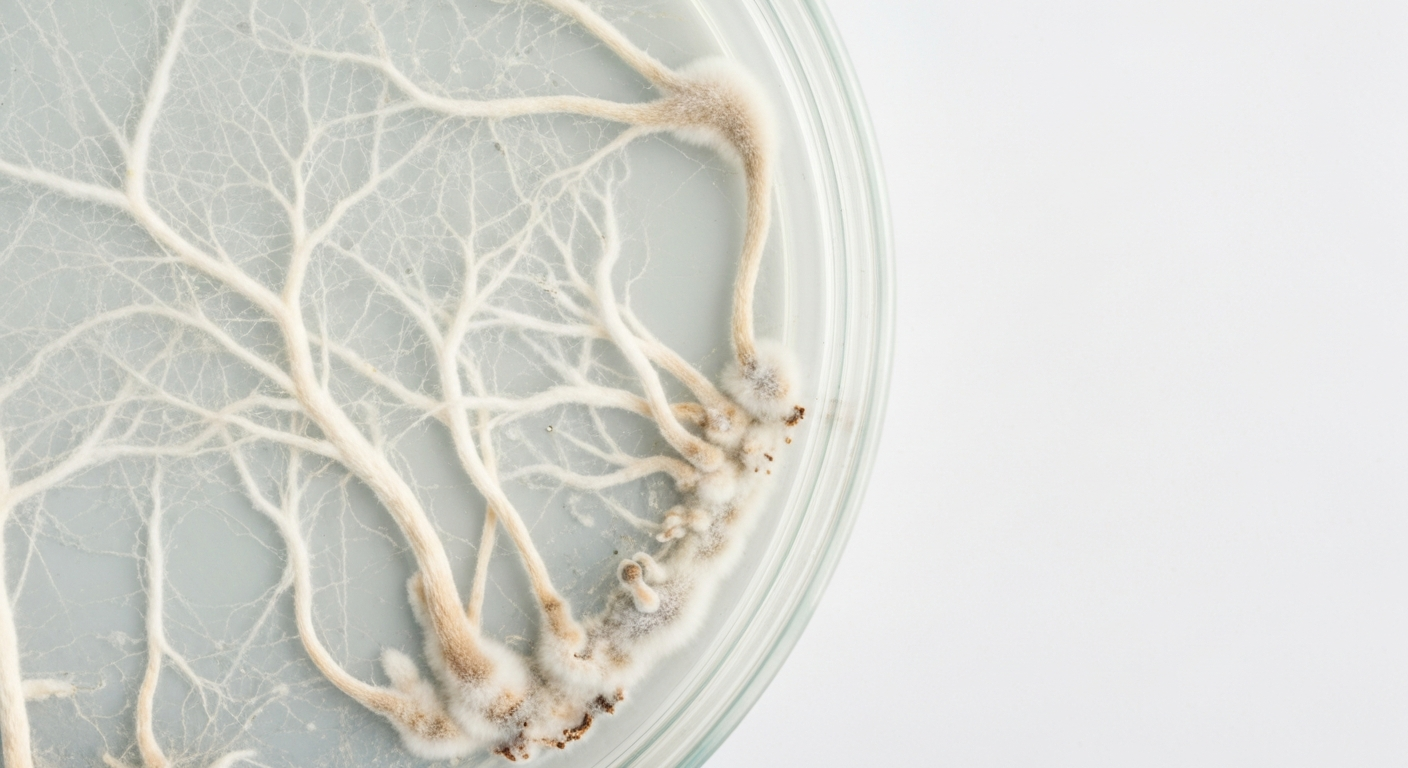
What it looks like: Cobweb mold is wispy, grey, and. as the name suggests. looks like actual cobwebs draped over the substrate surface. It's distinctly different from healthy mycelium, which tends to be brighter white, denser, and more ropey or rhizomorphic. Cobweb is grey, fluffy, and incredibly fine. It grows fast. you can sometimes see it visibly spreading over a few hours. It also tends to grow upward off the substrate surface rather than colonising into it.
What to do: This is one you can actually fight. Mix 3% hydrogen peroxide (the standard stuff from the chemist, about 50p a bottle) in a spray bottle and mist it directly onto the cobweb mold. The peroxide kills the cobweb on contact. you'll literally see it dissolve and collapse. It doesn't harm healthy mushroom mycelium at this concentration. Increase your fresh air exchange as well, because cobweb thrives in stagnant, high-CO2 environments. I've successfully saved multiple tubs from cobweb with nothing more than a couple of peroxide sprays and cracking the lid open a bit more.
Quick note: a lot of beginners on Reddit mistake healthy tomentose (fluffy) mycelium for cobweb mold. Tomentose mycelium is white and cottony. Cobweb is grey and wispy. If it's white and fluffy, it's probably fine. leave it alone.
Bacterial Blotch
Bacterial blotch (usually caused by Pseudomonas species) affects the mushroom fruit bodies rather than the substrate. It's not usually fatal to your grow, but it does make the mushrooms look unsightly and can affect texture.
What it looks like: Brown, slimy, or sticky patches on the caps of your mushrooms. The affected areas look water-soaked and often feel slimy to the touch. In severe cases, the entire cap turns brown and the mushroom becomes soft and unpleasant. It's caused by bacteria that thrive in wet, poorly ventilated conditions. typically from misting directly onto the fruit bodies or having poor air circulation.
What to do: Increase your FAE immediately. Stop misting directly onto the mushrooms. mist the walls and lid of your tub instead, or better yet, use a humidifier if your setup allows it. The affected mushrooms are still safe to eat if the blotch is minor, but badly affected ones are best discarded. Future flushes from the same tub should be fine once you've sorted out the ventilation. I had a persistent bacterial blotch problem on one grow that cleared up completely when I loosened the polyfill in my monotub FAE holes.
Wet Rot / Sour Smell
Wet rot isn't one specific organism. it's a general term for what happens when anaerobic bacteria take over your substrate. It's almost always caused by the substrate being too wet, having poor drainage, or insufficient air exchange.
What it looks like: The substrate turns dark, soggy, and develops a distinctly sour or fermented smell. Sometimes you'll see a slimy film on the surface. Mycelium growth stalls or retreats. In bad cases, the entire tub smells like vinegar or rotting fruit when you open the lid. If you poke the substrate and water pools in the depression, it's far too wet.
What to do: Mild cases can sometimes be rescued by dramatically increasing FAE. take the lid off entirely for an hour to let excess moisture evaporate, then return to normal fruiting conditions with extra ventilation. But I'll be honest with you: I've only successfully rescued one tub out of the four or five that have gone wet-rot on me. If the sour smell is strong and the mycelium has clearly stalled, cut your losses and start over. The lesson for next time is to nail your field capacity. that squeeze test is your best defence against wet rot.
Lipstick Mold
Lipstick mold (Sporendonema purpurascens) is less common than trichoderma or cobweb, but it shows up occasionally, particularly in grain jars. It gets its name from its distinctive pinkish-red colour.
What it looks like: Bright pink to reddish-orange patches, usually on grain surfaces. It's pretty unmistakable. there's nothing else that colour in a healthy mushroom grow. It tends to appear during colonisation rather than fruiting.
What to do: Bin the affected jar or bag. Lipstick mold isn't quite as aggressive as trichoderma, but it indicates a sterilisation failure and the grain is compromised. Don't try to salvage it. Clean your pressure cooker, check your processing times (90 minutes at 15 PSI for grain jars), and make sure your jar lids are sealing properly. I've seen lipstick mold twice in about 18 months of growing. both times it was because I'd tried to rush the pressure cooker and only processed for 60 minutes.
When to Save vs When to Bin
This is the hardest call in mushroom growing, especially when you've spent weeks colonising a tub. Here's my honest assessment after dealing with contamination more times than I'd like to admit:
- Save: Cobweb mold (hydrogen peroxide works), minor bacterial blotch (fix ventilation), very mild surface discolouration that hasn't spread after 48 hours.
- Bin: Trichoderma (any amount of visible green sporulation), lipstick mold in grain, severe wet rot with strong sour smell, any contamination in grain jars that haven't finished colonising, black mold (Aspergillus niger. rare but dangerous, don't mess about with this one).
- Judgement call: Small bacterial patches on the substrate surface (not on mushrooms), minor discolouration in a nearly-fully-colonised tub, faint off-smells that might just be metabolites.
My general rule: if in doubt, bin it. Substrate is cheap. Your time and your next grow's health aren't. A contaminated tub sitting in your growing space is pumping out competitor spores that can infect your other projects.
Prevention Strategies
Prevention beats treatment every single time. Here's what I do to keep contamination rates low:
- Use a still air box (SAB) for all grain work. A clear plastic tub with two arm holes cut in one side. It's not a laminar flow hood, but it reduces airborne contamination dramatically. I went from about a 30% contamination rate to under 5% when I started using one consistently.
- Proper sterilisation times. 90 minutes at 15 PSI for grain jars. 2.5 hours for supplemented sawdust. Don't rush it. If you're not sure your PC is maintaining pressure, get a better gauge. Check the grain spawn guide for detailed PC instructions.
- Nail your field capacity. Do the squeeze test on every batch. Too wet is worse than slightly too dry.
- Clean growing space. I wipe down all surfaces with isopropyl alcohol before any work. No open windows. No fans running. I don't even make toast before a grain inoculation session. airborne flour is loaded with trich spores.
- Fast, healthy spawn. A vigorous culture on clean grain will outcompete most contaminants. Use a good spawn-to-substrate ratio (1:2 or 1:3) so colonisation is quick. The faster your mycelium takes over the substrate, the less opportunity contaminants have.
- Don't reuse substrate. Spent substrate goes in the outdoor bed or the compost bin, not back into a monotub.
- Isolate contaminated tubs immediately. The moment you spot something wrong, move that tub away from your other grows. Deal with it outside if possible.
Contamination is frustrating, but it's also one of the best teachers in this hobby. Every lost tub teaches you something about your process. My contamination rate has dropped massively over the past year, and it's purely down to getting more disciplined about the basics. sterile technique, field capacity, and clean working conditions.
Frequently Asked Questions
Is green mold always trichoderma?
Not always, but in a mushroom growing context it usually is. Penicillium and Aspergillus can also appear green or blue-green, but trichoderma is by far the most common green contaminant in monotubs and grain jars. The key identifier for trichoderma is how fast it spreads. it can go from a small patch to covering half your tub in 24-48 hours. Penicillium tends to spread more slowly and often has a powdery, blue-green appearance rather than the bright forest green of trich. Regardless of which one it is, green mold in your tub means the same thing: that grow is compromised.
Can I cut out a contaminated section and save the rest?
It depends on what the contaminant is and how far it's spread. For a small patch of bacterial blotch on the surface, yes. you can sometimes scoop it out with a clean spoon, apply some hydrogen peroxide, and carry on. For trichoderma, honestly no. By the time you can see the green sporulation, the trich mycelium has already spread far beyond the visible patch. Cutting it out just delays the inevitable. Cobweb mold is the one exception where spot treatment (hydrogen peroxide spray) actually works reliably, because it's fragile and doesn't have the aggressive underground spread that trich does.
My substrate smells sour. Is it contaminated?
A sour, vinegary, or off-putting smell is almost always a sign of bacterial contamination, usually caused by the substrate being too wet or having anaerobic pockets. Healthy mycelium smells clean and slightly mushroomy. some people describe it as earthy or like fresh mushrooms. If your tub smells sour, acidic, or like rotting fruit, bacteria have taken hold. This often happens when substrate moisture is above field capacity, or when there isn't enough fresh air exchange. Unfortunately, bacterial contamination is difficult to reverse. You can try increasing FAE and hoping the mycelium outcompetes, but in my experience it's usually better to start over.