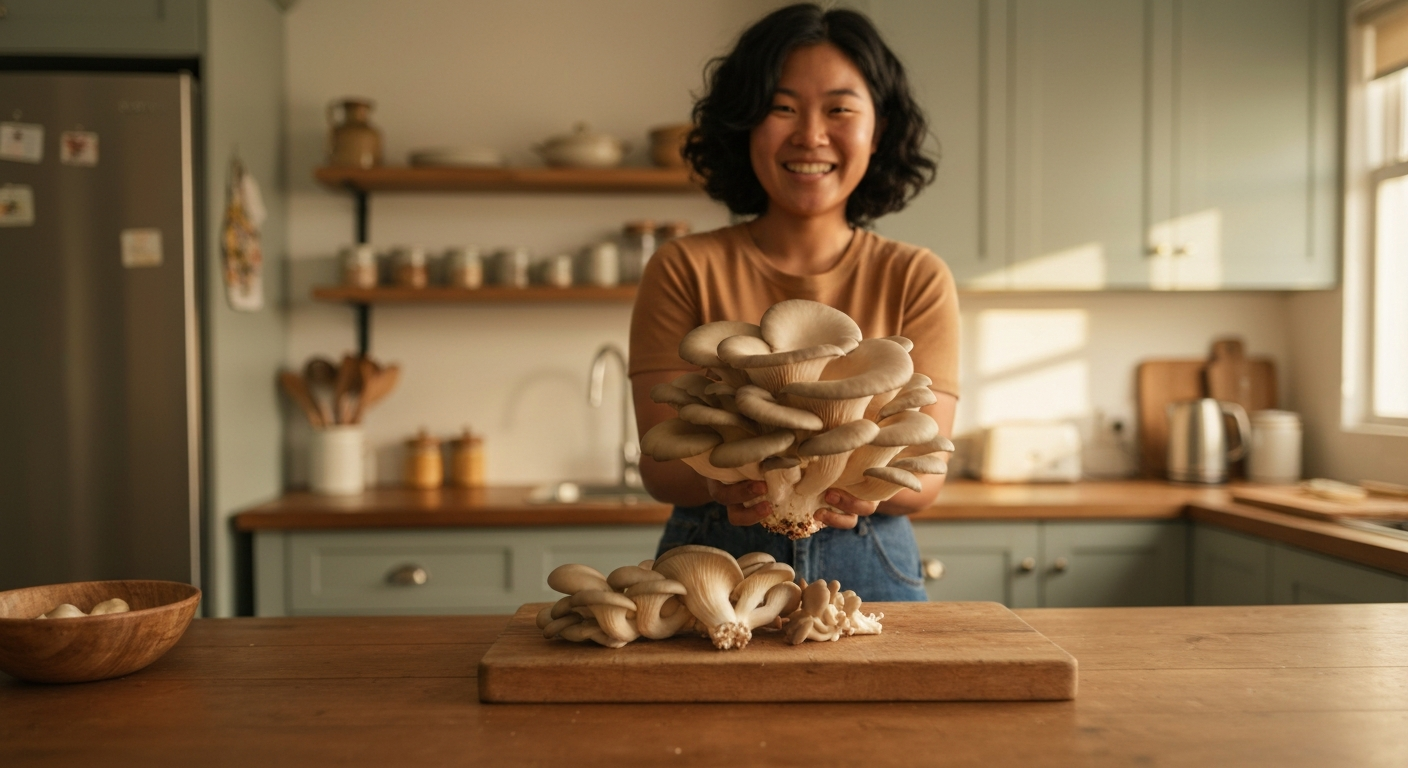
I started growing mushrooms in my kitchen three years ago because I was spending a frankly embarrassing amount on oyster mushrooms at the farmers' market. Eight quid for a punnet that barely filled a stir-fry. There had to be a better way, and there was. but the internet made it seem far more complicated than it actually is.
This guide is everything I wish someone had told me on day one. No jargon without explanation, no assumed knowledge, and real numbers. what things cost, how long they take, and what yields to expect. If you've never grown a mushroom in your life, you're in exactly the right place.
Why Grow Mushrooms at Home?
Before you invest time and a modest amount of money, here are the honest reasons why home mushroom cultivation is worth it:
- Cost savings are real. A 60-litre monotub of oyster mushrooms produces 600-1200g across two flushes. That's roughly £15-30 worth of shop mushrooms from about £3 in materials. My grows now cost me less than 50p per 100g of gourmet mushrooms.
- Freshness you can't buy. Supermarket mushrooms are typically 5-10 days old by the time you eat them. Home-grown mushrooms go from substrate to pan in the same hour. The texture and flavour difference is genuinely striking. crispy edges on fried oysters, meaty bite from fresh shiitake, none of the rubbery sadness of an aging punnet.
- Species you can't find locally. When was the last time you saw fresh lion's mane in Tesco? Or pink oysters? Or king oysters that weren't vacuum-packed and shipped from the other side of Europe? Growing your own opens up species that are practically impossible to buy fresh in the UK.
- It's a genuinely satisfying hobby. I'll be honest. watching mycelium colonise a jar is oddly therapeutic, and harvesting your first cluster of mushrooms feels properly rewarding. It scratches the same itch as gardening but works year-round indoors.
- Small space, low time investment. A monotub takes up less shelf space than a bread machine. Active work totals maybe 3-4 hours spread across an entire 8-week grow cycle. The rest is waiting.
The Three Best Species for Beginners
There are thousands of mushroom species, but only a handful are practical for a first-time home grower. I've grown about twenty different species over the past three years, and these three are the ones I always recommend to beginners. I'll give you the honest pros and cons of each.
Oyster Mushrooms (Pleurotus ostreatus)
Oysters are the undisputed champion of beginner mushroom growing. If you only ever grow one species, make it this one.
Pros:
- Colonises extremely fast. often the fastest species in any comparison test
- Aggressive mycelium outcompetes most contaminants, which is massively forgiving for beginners still learning sterile technique
- Grows on almost any cellulose substrate: straw, coco coir, hardwood sawdust, even coffee grounds or cardboard
- Fruits across a wide temperature range (15-24°C), meaning most UK homes are naturally suitable year-round
- Multiple flushes. I routinely get three flushes from a single tub
- Excellent yields: 400-800g per flush from a standard monotub
- Delicious. Seriously. Pan-fried in butter with garlic and a bit of thyme, they're better than anything from a shop
Cons:
- Spore load can be heavy. they drop a lot of white spores when mature, which makes a mess and can irritate airways in enclosed spaces. Harvest promptly to avoid this.
- Short shelf life once picked. best eaten within 2-3 days. Not great for stockpiling, though they dehydrate well.
- Considered "common" by some growers, but I think that's a silly reason to avoid them.
My recommendation: Start with grey oysters (Pleurotus ostreatus) or blue oysters (Pleurotus ostreatus var. columbinus). Both are incredibly robust. Pink oysters (Pleurotus djamor) are beautiful but need warmer temperatures (20-30°C) that can be hard to maintain in a UK home outside of summer.
Shiitake (Lentinula edodes)
Shiitake is probably the most commercially valuable gourmet mushroom you can grow at home. Fresh shiitake from a supermarket runs £4-6 for a tiny 150g pack. Growing your own is absurdly cost-effective by comparison.
Pros:
- Rich, savoury umami flavour that dries and stores brilliantly. dried shiitake keeps for over a year
- Good shelf life compared to oysters. 5-7 days in the fridge
- Grows well on hardwood sawdust blocks, which are straightforward to prepare
- Can be grown outdoors on hardwood logs (oak is ideal) for a very low-maintenance setup
- Strong market value if you ever want to sell at a local farmers' market
Cons:
- Slower colonisation than oysters. typically 6-8 weeks for a supplemented sawdust block
- More temperature sensitive. Prefers 12-20°C for fruiting, which can be tricky in a heated house during winter
- Requires hardwood sawdust substrate (usually supplemented with wheat bran), which is slightly more involved than CVG
- Some strains need a cold shock (a drop to 10-12°C for 24 hours) to trigger fruiting, which means sticking the block in an unheated garage or shed
My recommendation: Try shiitake as your second or third species, once you've got a successful oyster grow under your belt. The substrate preparation is different enough that you want the confidence of knowing your sterile technique works before investing the extra time. If you want the outdoor log approach, check out the indoor vs outdoor growing guide.
Lion's Mane (Hericium erinaceus)
Lion's mane is the one that impresses everyone who sees it. It looks like a fluffy white hedgehog growing out of your substrate, and it tastes like crab meat when sliced thick and pan-fried. It's also become extremely popular for its potential cognitive health benefits, which drives the price to £6-8 per 150g when you can actually find it fresh.
Pros:
- Unique flavour and texture. genuinely unlike any other mushroom. Meaty, seafood-like, brilliant in stir-fries
- High commercial value, rarely available fresh in UK shops
- Grows well on hardwood sawdust or supplemented straw
- No spore mess. lion's mane doesn't dump spores everywhere like oysters do
- Visually stunning, which makes the hobby more fun
Cons:
- More humidity-sensitive than oysters or shiitake. Needs 90%+ humidity during fruiting, consistently. Below 85% and the teeth yellow and dry out
- Moderately slow coloniser. not as quick as oysters, though faster than shiitake on sawdust
- Prefers to fruit from a single opening rather than across a surface, so the growing technique differs from oysters. Top-fruiting bags or buckets with a single hole work better than monotubs for lion's mane
- Genetics matter a lot. cheap lion's mane cultures sometimes produce disappointing, straggly fruit bodies. Buy from reputable vendors
My recommendation: Lion's mane is a brilliant third species to try. The growing method is slightly different (I prefer fruiting bags with a single cut rather than monotubs), but if you can maintain high humidity, the results are spectacular. My first successful lion's mane weighed 380g from a single fruit body. that's about £15 worth from one bag.
Equipment List with Costs
Here's everything you need to get started, with what I actually paid for each item. Total startup cost is roughly £40-60 depending on whether you buy new or hunt for second-hand deals.
- Pressure cooker (15 PSI capable). £30-50. The Presto 23-quart is the go-to. Second-hand on eBay or Facebook Marketplace is fine. This is your biggest expense and a one-time purchase.
- Still air box. £5. A 60-80 litre clear plastic tub from Wilko or Homebase. Cut two arm holes in one end. That's it. Some people add rubber gloves but I've never bothered.
- Mason jars (wide-mouth). £8-10 for a set of 6-8. Modify the lids with a 6mm hole covered in micropore tape.
- Spore syringe or liquid culture. £8-12. Buy from a reputable UK vendor with reviews.
- Whole rye grain. £8 for 25 kg from an agricultural feed supplier. Lasts months.
- Coco coir brick. £2 from garden centres or pet shops (sold for reptile bedding).
- Vermiculite (coarse grade). £3 for 10 litres.
- Gypsum. £4 for 1 kg.
- Monotub. £5-8. A 50-80 litre clear plastic tub. See the monotub setup guide for modification details.
- Micropore tape. £1 per roll from any chemist.
- Polyfill. £2 from craft shops.
- Spray bottle. £1 from Poundland. Fine mist setting.
- Rubbing alcohol (70% isopropyl). £3-4 for 500ml. For wiping down surfaces and tools.
- Lighter or butane torch. For flame-sterilising needles. You probably already own one.
Optional but helpful:
- Seedling heat mat + thermostat. £15-20. Keeps colonisation temperature consistent at 24°C. Especially useful if your house gets cold at night.
- Petri dishes + agar powder + malt extract. £10-15 total. For agar work. Not essential for your first grow but a game-changer for your second.
- Digital thermometer/hygrometer. £5-8. Useful for monitoring conditions, though you'll develop a feel for it over time.
Your First Grow: Step by Step
Right, let's walk through an actual first grow from start to finish. I'm going to assume you're growing grey oyster mushrooms using a liquid culture syringe inoculated directly into grain (no agar for your first time. we'll keep it simple). For the full deep-dive version of this process, see the from spore to harvest guide.
Step 1: Set Up Your Workspace
You don't need a laboratory. You need a clean kitchen table, a still air box, and a bottle of 70% isopropyl alcohol.
Build your still air box (SAB): take a large clear plastic tub (60-80 litres), flip it upside down, and cut two holes in one end big enough to fit your forearms through. That's your sterile workspace. Before each use, wipe the inside with isopropyl alcohol and let it settle for a minute. this kills airborne bacteria and mould spores that have landed on the surfaces.
Close windows and doors in the room you're working in. Turn off fans. You want as little air movement as possible. My mate suggested I work in the bathroom because there's no carpet (carpet kicks up an absurd amount of airborne contaminants), and he was right. my contamination rate halved when I moved from the living room to the bathroom.
Step 2: Prepare Grain Spawn
If you'd rather skip this step for your first grow, you can buy pre-made grain spawn from a vendor for about £10-15 per bag. Nothing wrong with that. But if you want to do it yourself. and I'd encourage it, because it teaches you loads. here's the summary:
- Rinse 1-2 kg of whole rye grain until the water runs clear
- Soak overnight (12-24 hours) in water with a tablespoon of gypsum per litre
- Drain and simmer for 10-15 minutes. hydrated but not bursting (thumbnail test)
- Dry on clean towels for 30-60 minutes until the surface is dry to touch
- Load into wide-mouth mason jars, two-thirds full, with modified lids
- Pressure sterilise at 15 PSI for 90 minutes
- Cool to room temperature (overnight is best. do not rush this)
The full version with all the nuances is in the grain spawn preparation guide. Seriously, read it before you attempt this. the details matter.
Step 3: Inoculate and Colonise
This is where sterile technique matters most. Everything from here is done inside your still air box.
- Wipe down the inside of the SAB with isopropyl alcohol. Let it settle for one minute.
- Place your cooled grain jars and liquid culture syringe inside the SAB.
- Flame-sterilise the syringe needle until it glows red. Let it cool for 10 seconds (don't blow on it).
- Shake the syringe gently to distribute the mycelium.
- Inject 1-2 ml of liquid culture through the micropore tape or injection port of each jar.
- Wipe the injection point with an alcohol-soaked cotton pad.
- Place jars in a warm, dark spot. a cupboard, a shelf in a spare room, anywhere that holds around 22-25°C.
Now comes the hard part: waiting. Don't shake the jars for the first 3-5 days. After you see visible white growth, give them a firm shake to break up the colonised grain and spread it around. Shake again at about 30% and 70% colonisation. Full colonisation takes 10-21 days.
The single biggest beginner mistake here is impatience. I lost my first three jars because I kept opening the SAB to check them, each time introducing more contaminants. Look through the glass. Take photos through the glass. Do not open anything.
Step 4: Make Your Bulk Substrate
While your grain is colonising, prepare your bulk substrate. For oyster mushrooms, CVG (coco coir, vermiculite, and gypsum) is reliable and cheap:
- Break up a 650g coco coir brick into a large bucket
- Add 2 litres of coarse vermiculite and 120g gypsum
- Pour 3-4 litres of boiling water over the mixture
- Stir thoroughly, seal the bucket, and leave for at least an hour (overnight is better)
- Once cooled to room temperature, check field capacity with the squeeze test. a hard squeeze should produce a few drops of water, no more
Total cost for this step: about £3. For more substrate options, including straw (which oysters love) and supplemented hardwood sawdust (for shiitake and lion's mane), see the substrate recipes guide.
Step 5: Spawn to Bulk, Colonise, and Fruit
Once your grain jars are fully colonised (100% white, no uncolonised grain visible), it's go time.
- Line your monotub with a black bin liner, pressed against the walls
- Break up your colonised grain jars into the tub
- Add bulk substrate and mix thoroughly. aim for a 1:3 spawn-to-substrate ratio
- Level the surface gently to a depth of 7-10 cm
- Optional: add a 1 cm casing layer of plain coco coir
- Close and seal the tub. Tape over the air holes with micropore tape
- Leave for 7-14 days at 22-25°C. Do not open it.
When the substrate surface is 75-100% colonised with white mycelium, switch to fruiting conditions: remove the tape from the holes, loosen polyfill if using it, and optionally crack the lid. Add ambient light (a desk lamp on a 12-hour timer works fine). The drop in CO2 and increase in FAE is what triggers pinning.
Pins (tiny baby mushrooms) should appear within 5-10 days. If the surface looks dry, mist lightly from above. aim for the sides and lid, not directly onto pins. Once pins form, growth is rapid. Oyster clusters can go from pin to harvest in 4-7 days.
The monotub setup guide covers tub modification, hole placement, polyfill vs micropore tape, and humidity management in much more detail.
Step 6: Harvest and Enjoy
Harvest oyster mushrooms when the cap edges flatten out and just begin to turn upward. Don't wait until they're fully curled. by that point they're dropping spores everywhere and the texture is past its best.
Grip the base of the cluster and twist it off in one piece. Clean removal reduces contamination risk between flushes. Expect 400-800g from your first flush of a 60-litre monotub. That's genuinely impressive for a first attempt.
After harvesting, clean up any stump remnants and aborted pins, then soak the substrate block in cold water for 6-12 hours. Drain and re-seal the tub. A second flush usually appears within 7-14 days, yielding 50-70% of the first flush. I regularly get a third flush too, though it's smaller and more sporadic.
Cook them immediately. that's the entire point. Oysters are incredible sliced and pan-fried in butter over high heat for 3-4 minutes per side until the edges are crispy. Add garlic, salt, and a squeeze of lemon at the end. I promise you'll never look at supermarket mushrooms the same way again.
Troubleshooting Common Issues
Here are the problems I see most often from beginners, and what to do about each one. I've made every single one of these mistakes myself, so there's no judgement here.
- Green, blue, or black mould in grain jars. That's contamination. usually Trichoderma (green) or Aspergillus (black). Do not open the jar indoors. Seal it and bin it. Review your sterilisation time (90 minutes at 15 PSI, no shortcuts) and inoculation technique. The contamination guide has photos and identification help.
- Grain jars not colonising after 2 weeks. Check temperature. below 20°C and colonisation slows dramatically. If jars were inoculated with spore syringes rather than liquid culture, germination can take 7-10 days before you see anything. Patience first, panic second.
- Substrate surface won't pin. Usually a FAE issue. Increase fresh air exchange by loosening polyfill, cracking the lid more, or fanning the tub 2-3 times a day with the lid for 30 seconds. Also check that humidity is high enough. you should see tiny water droplets on the substrate surface.
- Mushrooms have long thin stems and tiny caps. CO2 is too high. The mushrooms are stretching for fresh air. More FAE. This was my most common problem in my first year because I was terrified of losing humidity, so I kept the tub too sealed.
- Pins forming but then aborting (turning dark and stopping growth). Usually caused by a sudden environmental change. temperature swing, humidity crash, or misting directly onto the pins. Keep conditions as stable as possible once pins form. Slight misting of the tub walls and lid is fine; soaking the pins is not.
- Wet, slimy spots on the substrate surface. Bacterial contamination from overly wet substrate. If it's localised, you can sometimes scoop it out carefully and still get a partial harvest. Prevention: get the field capacity squeeze test right from the start, and don't over-mist.
- Side pins growing between substrate and tub wall. You forgot the liner. Or the liner pulled away from the substrate. Not a disaster. harvest them with tweezers. but use a liner next time. The monotub guide explains the technique.
What to Grow Next
Once you've nailed your first oyster grow. and you will, they're that forgiving. here's a sensible progression:
- Try a different oyster variety. If you started with grey oysters, try blue oysters (slightly different flavour, equally easy) or golden oysters (fruitier taste, needs warmer temps around 20-26°C). This builds confidence without changing your technique.
- Learn agar work. It adds a couple of weeks to your timeline but dramatically reduces contamination and gives you much more control over your cultures. An agar plate costs pennies to pour and lets you isolate clean, vigorous mycelium before it ever touches your grain.
- Grow shiitake. Different substrate (supplemented hardwood sawdust), slower colonisation, and potentially needs a cold shock for fruiting. But the flavour is extraordinary and they dry beautifully for long-term storage.
- Try lion's mane. Higher humidity requirements and a different fruiting approach (single opening bags rather than monotubs), but the results are stunning and the taste is unlike anything else.
- Experiment with outdoor growing. Inoculating hardwood logs with shiitake or oyster dowel spawn is a low-effort, long-term project. A single inoculated oak log can produce mushrooms for 3-6 years. See the indoor vs outdoor growing guide for how to get started.
The beautiful thing about this hobby is that each grow teaches you something. My fifth grow was twice as productive as my first, not because I changed anything dramatic, but because I'd developed a feel for moisture levels, colonisation speed, and when to intervene versus when to leave things alone.
Whatever species you start with, the fundamentals are the same: clean technique, proper hydration, patience during colonisation, and the discipline to stop fiddling once conditions are set. Get those right and you'll be harvesting your own gourmet mushrooms within a couple of months. Genuinely one of the most rewarding hobbies I've ever picked up.
Frequently Asked Questions
What is the easiest mushroom to grow at home?
Oyster mushrooms, hands down. They colonise fast, tolerate a wide temperature range (15-24°C for fruiting), grow on practically any cellulose-based substrate, and they're incredibly forgiving of beginner mistakes. I've accidentally left an oyster tub without misting for three days and it still fruited. You won't get that kind of resilience from lion's mane or shiitake. If it's your first ever grow, start with grey or blue oysters. they're the most aggressive colonisers and fruit reliably even in imperfect conditions.
How much does it cost to start growing mushrooms at home?
You can get started for about £40-60 if you're buying everything new. That covers a still air box (a plastic tub, so about £5), a pressure cooker (£30-50 second-hand), some mason jars (£8-10 for a set), a spore or liquid culture syringe (£8-12), grain (£8 for a 25 kg bag that lasts months), coco coir (£2), vermiculite (£3), and a plastic monotub (£5-8). The pressure cooker is the biggest expense and a one-time purchase. After your initial setup, each subsequent grow costs roughly £3-5 in consumables.
Do I need a pressure cooker to grow mushrooms?
For making your own grain spawn. yes, practically speaking. Grain needs to be sterilised (not just pasteurised) because it's so nutrient-rich that anything less will result in constant contamination. Some people get by with extended steam sterilisation, but the failure rate is much higher. However, if you buy pre-made grain spawn from a vendor, you can skip the pressure cooker entirely and just pasteurise your bulk substrate with boiling water. That's a perfectly valid approach for your first few grows.
How long does it take to grow mushrooms from start to finish?
From inoculation to first harvest, expect 6-10 weeks depending on the species. Oyster mushrooms are fastest. sometimes as quick as 5 weeks in ideal conditions. Shiitake typically takes 8-10 weeks. Lion's mane falls in between at 7-9 weeks. The bulk of that time is hands-off colonisation where the mycelium is doing its thing and you're just waiting. The actual active work. preparing grain, making substrate, spawning to bulk. adds up to maybe 3-4 hours spread across the entire grow.
Can I grow mushrooms in a flat or small space?
Absolutely. A single monotub takes up about the same space as a shoebox on a shelf. I grew mushrooms for my first year in a one-bedroom flat. the monotub sat on top of a wardrobe in the spare room. You need a small workspace for grain prep and inoculation (a kitchen table works fine), a cupboard or shelf for incubation, and the monotub itself for fruiting. The only spatial challenge is the pressure cooker, which needs hob access. If you're extremely tight on space, look into bucket grows for oysters. a 20-litre bucket in a corner produces respectable yields.